


On 18 August 2025, government representatives, university leaders, researchers, international organisations and technology experts gathered at Beijing Normal University for the forum “Artificial Intelligence Leading High-Quality Development of Higher Education.”
The forum was organised as part of the 2025 Global Smart Education Conference and jointly convened by UNESCO’s International Institute for Higher Education in Latin America and the Caribbean (UNESCO IESALC), institutions at Beijing Normal University and Huawei. Discussions examined how artificial intelligence was changing teaching, research, institutional governance, infrastructure and international cooperation.
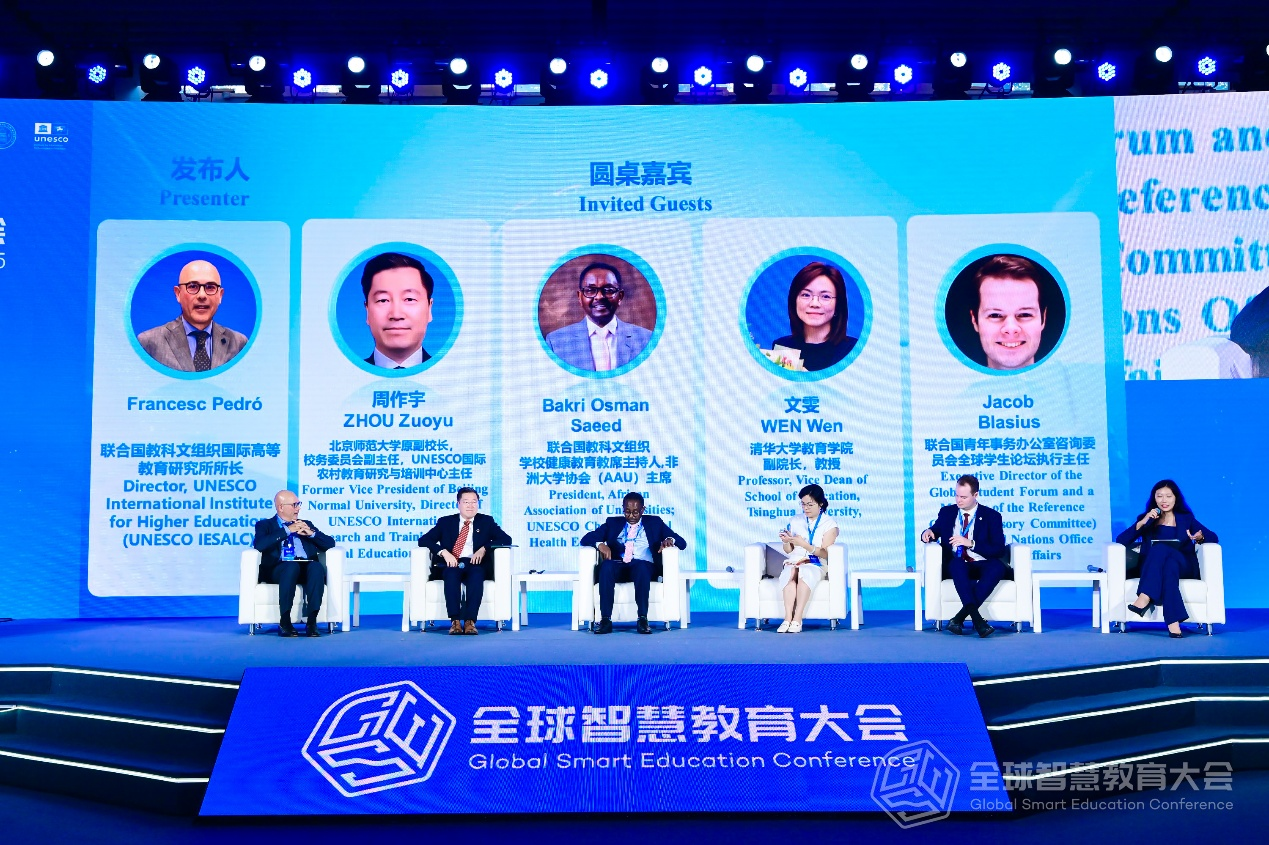
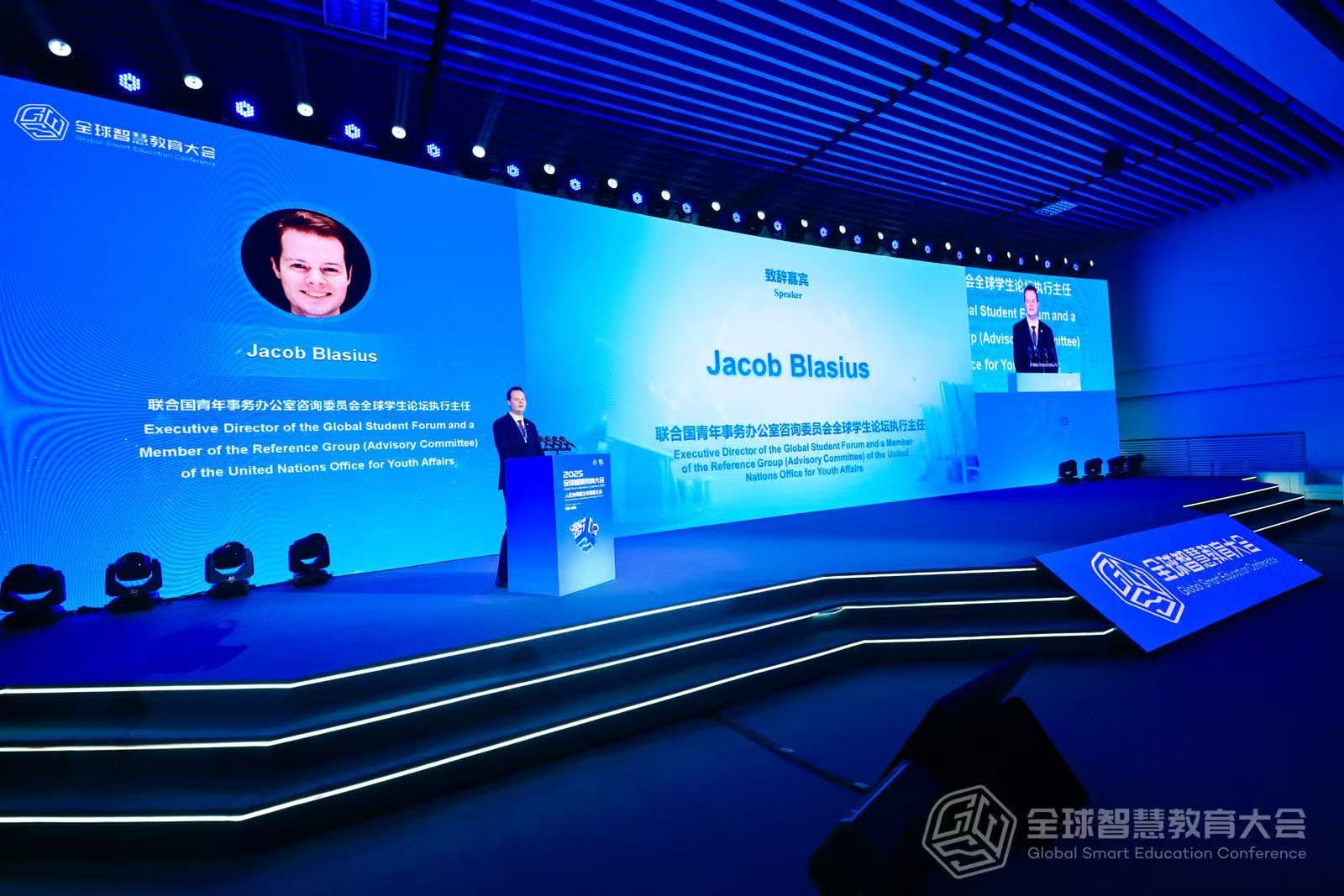
Representing the Global Student Forum, Executive Director Jacob Blasius brought a student perspective to both the main discussion and a roundtable on context-sensitive AI competency frameworks.
His intervention centred on two questions that remain unresolved today: How can higher education institutions respond to the anxiety and uncertainty created by artificial intelligence when policy continues to lag behind technological change? And which distinctly human capabilities must education protect and strengthen when machines can increasingly perform tasks previously associated with human knowledge and skill?
From rapid adoption to responsible governance
Nearly one year later, it is evident that artificial intelligence has not remained an experimental or marginal part of higher education.
A UNESCO survey involving 400 respondents from higher education networks across 90 countries found that nine in ten were already using AI professionally. At the same time, more than half expressed uncertainty about its effective use or had limited understanding of its technological, social and human-rights implications.
Only 19 per cent reported that their institution had a formal AI policy, although a further 42 per cent said guidance was being developed. One in four respondents said their institution had already encountered ethical concerns connected to AI, including overreliance, authorship disputes and bias.
UNESCO’s first global report on higher education trends, published in May 2026, similarly concluded that only around one in five universities had a formal AI policy in 2025. This governance gap exists within a global system now serving 269 million students, marked by significant inequalities in access, resources and institutional capacity.
The debate, therefore, can no longer focus only on whether students should be permitted to use generative AI. Students are already using it, educators are experimenting with it, and institutions are investing in it. The more important questions concern who establishes the rules, whose interests those rules protect and what kind of education the technology is being used to create.
Students cannot be treated as a risk to manage
In Beijing, Jacob argued that students must be recognised as central partners in the development of institutional responses to AI.
Too often, university policies are produced as emergency reactions to presumed student misconduct. They concentrate on surveillance, detection and punishment rather than learning, transparency and shared responsibility. This approach risks portraying students primarily as a problem while excluding them from decisions that will fundamentally reshape their education.
More constructive approaches are now beginning to appear. UNESCO’s research identifies institutions that are consulting students and educators, introducing AI literacy across the curriculum and redesigning assessment rather than relying exclusively on attempts to detect AI-generated work.
This shift matters. Meaningful participation cannot consist of presenting students with a finished policy and requesting comments shortly before its adoption. Students and their representative organisations should participate from the beginning: identifying problems, evaluating proposed technologies, examining risks and benefits, developing rules and reviewing how those rules operate in practice.
In 2026, UNESCO IESALC described this wider change as a movement away from treating young people as passive recipients and towards recognising them as co-creators of higher education. The Institute has emphasised that student participation is essential to building systems that are inclusive, equitable and responsive to contemporary challenges, including the rapid integration of AI.
Education must decide what should remain human
Artificial intelligence also requires higher education to reconsider what and how it teaches.
Universities should certainly prepare students to work critically and competently with emerging technologies. AI literacy must include more than knowing how to produce an effective prompt. Students need to understand how systems are trained, where their outputs may be unreliable, how data are collected, how bias is reproduced and who is accountable when automated decisions cause harm.
UNESCO IESALC has identified substantial gaps between the growing influence of AI and the preparedness of both students and educators. Its work on competency frameworks stresses that technical proficiency must be combined with an understanding of AI’s ethical, social and professional consequences.
However, preparing students to use AI is only part of the responsibility of education. Institutions must also protect the capabilities that should not be surrendered to it.
Critical judgement, intellectual independence, ethical reasoning, creativity, empathy, cooperation and the ability to engage with disagreement are not outdated skills made unnecessary by technological progress. They are essential human and democratic capacities. The purpose of education cannot be reduced to producing work more quickly or making institutions more administratively efficient.
AI should support human learning and agency; not replace the relationships, reflection and intellectual struggle through which meaningful education takes place.
Equity must be part of the conversation
Discussions about AI frequently assume that all students have similar access to devices, connectivity, paid platforms and digital skills. They do not.
Unequal access to technology means that uncritical AI integration may deepen existing educational divides. Students studying in underfunded institutions, rural areas, conflict-affected settings or low-income communities may be expected to compete with peers who have access to better infrastructure, more powerful tools and greater institutional support.
The same applies to language and culture. AI systems trained predominantly on content from a limited number of languages and regions may reproduce distorted or incomplete understandings of the world. Universities must therefore consider whose knowledge is represented, whose language is supported and whose experiences remain invisible.
Questions of privacy and ownership are equally important. Students should not be required to surrender personal information, academic work or intellectual property to private technology providers as an unavoidable condition of participating in education.
From principles to shared action
The Global Student Forum has consistently argued that students are not only beneficiaries of AI-enhanced education. They must be active participants in shaping it.
GSF’s Guidebook on AI in Education calls for transparency, privacy and data ownership, inclusive development, educator training and continued evaluation of AI tools. It also encourages student unions to monitor institutional practices, lead awareness initiatives and engage directly in policy discussions.
These commitments remain central to GSF’s strategic priorities for 2026. GSF calls for rights-based and transparent governance that protects privacy, equity and academic freedom while ensuring that technology amplifies human potential rather than widening inequality.
Nearly one year after the Beijing forum, the central message of Jacob Blasius’ intervention remains unchanged: higher education cannot manage the AI transformation through isolated policies developed behind closed doors.
Universities, governments, educators, students, researchers and technology providers need sustained structures for dialogue, cooperation and accountability. Within those structures, students must hold real influence and not only symbolic representation.
The future of artificial intelligence in higher education is not predetermined by the technology itself. It will be shaped by the choices institutions make, the values they protect and the people they allow to participate.
Students must be among those leading that process.


